"But I just saw you stand up!"
If you are an ambulatory wheelchair user, you have likely heard this phrase, or felt the weight of the "side-eye" that comes with it. There is a common misconception that wheelchair use is a binary: you are either unable to walk at all and use one 100% of the time, or you do not need one at all.
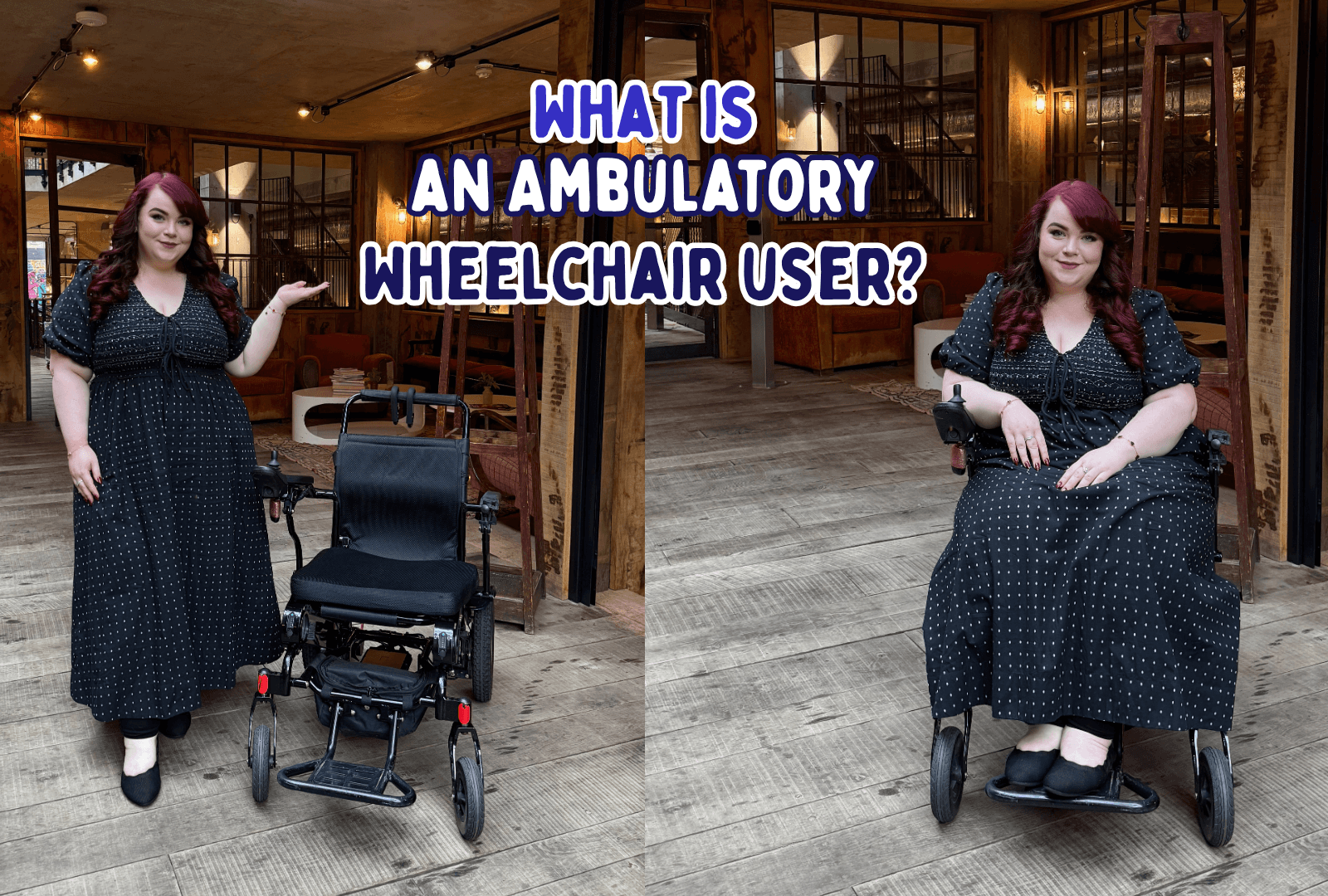
If you’ve ever wondered, 'Can you use a wheelchair if you can walk?', the answer is a resounding yes. An ambulatory wheelchair user is someone who uses a mobility aid but can also walk or stand depending on their environment and energy.
There are an estimated 1.2 million wheelchair users in the UK, and around a third of them use their wheelchair occasionally rather than regularly. Of the people using NHS wheelchair services, fewer than 1 in 5 are full-time users who rely on their wheelchair for all their mobility. Many ambulatory wheelchair users are managing chronic pain, fatigue, or conditions like POTS, EDS, or MS, where getting around on foot can be unsafe or unsustainable.
Defining the Term: What Does "Ambulatory" Actually Mean?
Ambulatory” simply means able to walk. Therefore, an ambulatory wheelchair user is someone who uses a wheelchair for mobility but has some level of ability to stand or walk in certain circumstances.
For many of us, the wheelchair is not a 'last resort' or a sign of restriction. It is a tool. Just as someone might use reading glasses to see clearly, we use wheelchairs to navigate the world without debilitating pain, dangerous fatigue, or the risk of injury.
The Statistics You Need to Know
One of the most surprising facts for the non-Disabled public is just how common this is.
Fewer than 1 in 5: Only around 18% of NHS wheelchair service users rely on their wheelchair for all their mobility.
Non-visible disabilities: Many ambulatory users have non-visible illnesses or chronic conditions, meaning you cannot see their impairment just by looking at them.
Fluctuating Access Needs: Mobility is often fluid. A person might be able to walk around their kitchen to make tea but require a wheelchair to navigate a shopping centre or a train station.
Why Someone Might Use a Wheelchair if They Can Walk
If someone can walk, why would they choose to use a chair? It usually comes down to three main environmental and physical factors: Pain Management, Energy Conservation, and Safety.
Chronic Pain and Joint Instability.
Conditions like Ehlers-Danlos Syndrome (EDS), Fibromyalgia, or Osteoarthritis can make navigating built environments incredibly painful. Using a wheelchair reduces the physical load on the joints, allowing the user to travel further than they ever could on foot.
2. Energy Limiting Conditions
For people with ME/CFS (Myalgic Encephalomyelitis) or Multiple Sclerosis (MS), energy is a finite resource. This is often explained through Spoon Theory, where every activity costs a "spoon." Walking 100 metres might use up all the energy a person has for the entire day. By using a wheelchair to bypass architectural barriers, they conserve that energy so they can actually participate in life once they arrive.
3. Postural and Neurological Issues
Conditions like POTS (Postural Orthostatic Tachycardia Syndrome) can cause a person’s heart rate to rise sharply when they stand up, leading to dizziness, fatigue and sometimes fainting (syncope). A wheelchair lets them stay seated and get around safely.
The Stigma: Why We Need to Stop the "Miracle" Narrative
We have all seen "inspirational" videos of a wheelchair user standing up to hug someone, often framed as a miracle. While these moments can be moving, they unintentionally fuel the stigma that seeing an ambulatory person stand up is a "gotcha" moment or proof of "faking it."
Disability is not defined by a single moment.
We need to shift our focus from the person to the environment. When I stand up to reach a shelf, my need for a mobility aid doesn't disappear. My wheelchair is still essential, because so many public spaces are designed without people like me in mind. Spaces aren’t inherently inaccessible. In the social model of disability, it is the lack of universal design and the presence of ableist assumptions that disable me, not the dynamic ways I choose to use my body.
How to Be a Better Ally to Disabled People
Don't Assume: If you see someone stand up from a wheelchair, do not assume they are 'cured' or exaggerating their access needs.
Respect the Space:Accessible toilets are for anyone who needs them, and Blue Badge bays are for any Blue Badge holder, including people whose impairments are not immediately apparent.
Speak Directly: Always address the person in the chair, not their companion or carer.
Ask First: Never touch or move someone’s wheelchair without their explicit permission. It is an extension of their personal space.
How Sociability Supports Ambulatory Users
One of the biggest hurdles for ambulatory users is "the unknown." We need to know exactly what barriers exist at a venue before we arrive.
Is the "accessible" entrance actually a long walk from the car park?
Are there places to sit and rest throughout the building?
Is the floor surface easy to navigate if I am feeling fatigued?
This is why our photo-led mapping with alt-text is so vital. By combining clear visual layouts with descriptive accessibility data, an ambulatory user, or anyone navigating a venue's environment, can decide: "Today is a walking day for this venue" or "Today, I definitely need my chair." Whether you are assessing a space visually or utilising screen readers to process our detailed entry descriptions, having the full picture beforehand removes the guesswork.
Frequently Asked Questions (FAQ)
Can you be a wheelchair user and still walk?
Yes. This is called being an ambulatory wheelchair user. Many people use wheelchairs to manage pain, fatigue, or balance difficulties, even if they can walk short distances.
Is it "lazy" to use a wheelchair if you can technically walk?
No. It is an essential tool used to prevent health crashes, mitigate chronic pain, and protect the user's autonomy.
What conditions do ambulatory wheelchair users have?
Common conditions include Multiple Sclerosis (MS), Ehlers-Danlos Syndrome (EDS), Fibromyalgia, POTS, ME/CFS, and various forms of Arthritis.
How should I react if I see a wheelchair user stand up?
React exactly as you would if they stayed seated: with respect. Their ability to stand for a moment does not negate their health condition, their identity, or their need for a mobility aid.
Does Sociability only map places for full-time wheelchair users?
Not at all. Our detailed accessibility information is designed for everyone, including ambulatory users, those with non-visible or non-apparent disabilities, and people using walking sticks, crutches or rollators, who need to plan their energy expenditure.
Whether you are a full-time wheelchair user, an ambulatory user, or someone whose access needs change day to day, Sociability is designed for you.
Download the app to find venues with detailed information such as seating, lift access, and sensory considerations, so you can decide whether today is a walking day, a chair day, or somewhere in between.
Sign up to Beyond Compliance, our newsletter on accessibility and inclusion.

Georgina Grogan
Georgina is the Community Engagement Officer at Sociability. Bringing 12 years of lived experience as a Disabled content creator, she handles SEO and blog writing to successfully build and engage our community